
Urjit Patel as the new RBI governor whose focus is on taming inflation has lowered the probability of interest rate cut soon

Over the past one-and-half years, the number of stocks trading below their respective face value has increased 29 per cent after a sharp correction in stocks of small-cap companies.

Moody's Investors Service on Thursday slashed India's economic growth projection to 8.8 per cent for 2022 from 9.1 per cent earlier, citing high inflation. In its update to Global Macro Outlook 2022-23, Moody's said high-frequency data suggests that the growth momentum from December quarter 2021 carried through into the first four months this year. However, the rise in crude oil, food and fertilizer prices will weigh on household finances and spending in the months ahead.
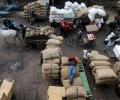
The Indian economy remains on track to regain its position as the world's fastest-growing major economy after official estimates on Friday put the expansion at a tempered 9.2 per cent this fiscal amid concerns over the impact of a resurgent virus on the fragile recovery. The growth in the gross domestic product (GDP) of 9.2 per cent in April 2021 to March 2022 fiscal (FY 2021-22) given by the National Statistical Office (NSO) in its first advance estimate compares with 9.5 per cent expansion forecast by the Reserve Bank of India (RBI) last month. The economy had contracted by 7.3 per cent in the previous financial year.

Notwithstanding the inflation pinch, analysts believe the Indian retail sector is on the 'cusp of accelerated earnings growth' as consumer sentiment and discretionary purchases bounce back from the Covid-19 pandemic. "The shift in consumer preference from the unorganised sector to the organised, coupled with uptick in domestic demand as people resume work from office, will cheer the Indian retail sector," says Nishit Master, portfolio manager, Axis Securities. Shopping malls are witnessing increased footfall in lower tier towns and standalone stores as consumption picks up and mobility improves.
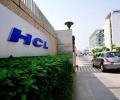
Shares of HCL Tech hit a fresh record high of Rs 1,118.55 on Friday, up 2 per cent on the BSE in intra-day trade, surpassing its previous high of Rs 1,101 touched on Thursday in intra-day deals.
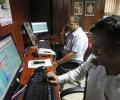
S&P BSE Midcap and the S&P BSE Smallcap indices gained 2% and 1.6% respectively

L&T was the top gainer in the Sensex pack, rising over 3 per cent, followed by Bajaj Finance, Reliance Industries, IndusInd Bank, SBI and HDFC Bank. NSE Nifty surged 168.05 points to 14,653.05.

market rally, especially in mid-caps, has also been driven by a pick-up in the monsoon and the government's resolve to get the goods and services tax (GST) Bill cleared in the recent session of Parliament.

IPO-bound mobility platform Ola, said it has successfully raised $500 million via a Term Loan B (TLB) from marquee international institutional investors. This term loan has no impact on the valuation of Bhavish Aggarwal-led Ola. The Bengaluru-based firm recently raised $139 million. This is part of a $1 billion funding round for which the company is in talks with investors, increasing its valuation to about $7.5 billion, according to the sources.
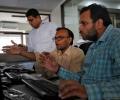
A favourable monsoon and government support to the rural economy are among the reasons that agrochemical companies, including makers of pesticides and fertilisers, have done well.

Many years during which monsoons were poor saw high returns, while normal or excess rainfall has also coincided with poor calendar year gains.

Moody's Investors Service on Tuesday slashed India's growth forecast for the current financial year to 9.3 per cent saying that the second wave of coronavirus infections hampers economic recovery and increases risk of longer-term scarring. Moody's, which has a 'Baa3' rating on India with a negative outlook, said obstacles to economic growth, high debt and weak financial system contrain sovereign credit profile. The US-based rating agency had in February forecast a 13.7 per cent economic growth for the current fiscal (April 2021-March 2022).
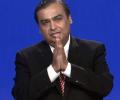
Reliance Industries Ltd, the nation's most valuable company, on Thursday said it has raised $4 billion (around Rs 30,000 crore) in debt through the largest ever foreign currency bond issuance by an Indian entity. The oil-to-telecom conglomerate plans to use the proceeds of the three tranche issues to retire existing borrowings. The issue was "nearly 3 times oversubscribed with a peak order book aggregating around $11.5 billion," the company said in a statement. This is the largest ever foreign currency bond transaction in India, eclipsing ONGC Videsh Ltd's $2.2 billion US dollar bonds issue of 2014.

India has emerged as the brightest spot in the Asia Pacific region as reform has picked up pace in the country in recent months, a top credit rating agency has said.
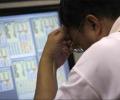
Banks led the decline with Nifty Bank and BSE Bank index dropping over 3% each.

It won't be easy for the banking sector to better its performance every quarter, predicts Tamal Bandyopadhyay.

The S&P BSE Midcap and the S&P BSE Smallcap indices under-performed to lose 0.8% and 1.6%

Shares of IT companies were in focus with the Nifty IT and S&P BSE IT index gaining more than 2% in an otherwise lower market

The S&P BSE Midcap and the S&P Smallcap indices rallied over 1% each

The breadth, indicating strength of the market was strong

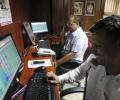
Metals, auto and banking shares were in the limelight in this session; the FMCG pack, however, ended lower.
The S&P BSE Midcap and S&P BSE Smallcap indices gained 0.4% and 1%, respectively
BSE IT index was the biggest sectoral loser, down 1.5% dragged by TCS
The S&P BSE Midcap and the S&P BSE Smallcap indices gained 0.3% and 0.5%, respectively

The S&P BSE Sensex plunged 301 points to close at 25,490 and the Nifty50 fell 86 points to end at 7,815.
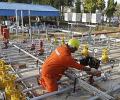
It is rare for Cabinet ministers to tick off state-owned companies publicly, yet that was what then petroleum and natural gas minister Dharmendra Pradhan did for ONGC. Speaking at an event on June 29, Pradhan said he has asked India's premier exploration company to find fresh oil acreages fast. "Do it yourself through some joint venture (or) through a new business model. But the government cannot permit you to hold resources for an indefinite time." The reason for this stricture is India's rising dependence on imported oil and gas. Or, to put it another way, falling domestic production (see chart: "Crude truth"), especially from ONGC, which faces a simple problem.

Analysts caution against volatility and recommend buying stocks of companies that are on strong fundamental footing that have been beaten down badly in the recent carnage.
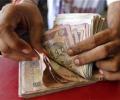
The rupee hit a near 10-month high as an alliance led by pro-reform and business friendly Hindu nationalist Narendra was on course for an absolute majority.

The economic impact of the Omicron variant of COVID-19 on emerging economies will depend on a mix of government restrictions, public comfort with social interactions, and capacity of governments and central banks to provide additional policy support to the private sector, Moody's Investors Service said on Wednesday. The emergence of the new variant poses new risks to the global economic growth and inflation outlook, as concerns mount about the variant's health risks and several countries have imposed new travel restrictions in recent days. These restrictions will likely increase over the coming weeks until scientists learn more about the variant, it said.

There is immense pressure on Biyani to go ahead with the RIL offer after FRL defaulted on its interest payments of Rs 100 crore on July 22.

S&P BSE Midcap index and S&P BSE Smallcap were down 2% and 1.3% respectively

It is not clear as to whether we are in a bubble in technology stocks. What is clear, however, is that there is no reason why this potential bubble will pop anytime soon, notes Akash Prakash.
The broader market outperformed with the S&P BSE Midcap down 0.3%, while the S&P BSE Smallcap was little changed.
Broader market underperformed with the BSE Midcap and the BSE Smallcap indices losing up to 0.2%

The BSE Midcap and the BSE Smallcap indices pared all intraday gains to end 0.3% and 0.5% lower

The divestment process, however, will not be an easy affair as there are multiple stakeholders, including the employee unions, whose concerns will have to be addressed.

The 30-share BSE Sensex surged by 477.24 points or 0.83 per cent to close at more than one-week high of 57,897.48. As many as 28 of its constituents closed with gains while two declined. The broad-based Nifty of the National Stock Exchange rose by 147.20 points or 0.86 per cent to settle 17,233.45, tracking gains in Sun Pharma, Asian Paints, and Reliance Industries.

In the broader market, the S&P BSE Midcap and the S&P BSE Smallcap indices gained 0.5% and 0.4%, respectively.
 © 2026 Rediff.com - Advertise with us - Disclaimer - Privacy Policy - Sitemap - Feedback - About us - Terms of use - Grievances